A core bit that drills fast on one concrete slab can glaze, wander, or lose segments on the next job. The difference is often not drilling technique. It is selection. This diamond core bit selection guide helps contractors, distributors, and procurement teams match bit specifications to the material, drilling method, and production demands behind each order.
For commercial drilling, the lowest unit price is rarely the lowest operating cost. A bit that requires repeated dressing, overheats under reinforcement, or produces inconsistent holes slows the crew and creates avoidable replacement demand. The right specification should deliver predictable penetration, controlled wear, clean hole geometry, and stable performance from one batch to the next.
Start With the Material, Not the Bit Diameter
Concrete is not one material category. Its aggregate hardness, compressive strength, reinforcement content, age, moisture level, and curing condition all affect diamond tool performance. A bit selected only by diameter and working length may fit the drill motor but still be poorly matched to the application.
Soft, abrasive concrete generally wears the metal matrix quickly. It needs a harder bond that holds diamonds in place long enough to cut efficiently. Hard or dense concrete requires a softer bond that releases worn diamonds and exposes fresh cutting points. If the bond is too hard in dense material, the bit may polish over rather than cut. If it is too soft in abrasive material, segment wear can become excessive.
Reinforced concrete adds another requirement. The bit must cut both mineral aggregate and steel without losing cutting speed or segment integrity. For frequent rebar contact, specify a reinforced-concrete core bit with a segment formulation designed for mixed-material drilling. A general masonry bit may drill occasional steel, but it is not the best choice for repeated structural work.
Brick, block, and softer masonry usually require a different balance. These materials can be abrasive and may not justify the same segment specification used for high-strength reinforced concrete. Selecting a bit specifically for masonry can improve life and reduce unnecessary tool cost, especially for distributors supplying electrical, plumbing, and HVAC contractors.
Diamond Core Bit Selection Guide: Choose the Right Bond
The bond is the metal matrix that retains the diamonds in each segment. It controls diamond exposure, cutting speed, and segment wear. In practical purchasing terms, bond selection determines whether the bit stays open and productive throughout the job.
A soft bond is typically used for hard, dense, less-abrasive materials. As the bond wears, new diamond crystals are exposed. This keeps the cutting edge active on cured concrete, hard aggregate, and other demanding materials. The trade-off is faster segment consumption if the bit is used in soft or highly abrasive concrete.
A hard bond is generally more suitable for softer, abrasive materials. It resists wear and prevents diamonds from being released too quickly. However, a hard-bond bit used on very dense concrete may become glazed. The operator will notice slower penetration, increased heat, and a polished segment surface with little exposed diamond.
For distributors building an inventory range, the most reliable approach is not to stock one universal bond. Carry application-focused options: a general-purpose reinforced concrete line for broad contractor demand, a premium hard-concrete line for high-strength applications, and a masonry-focused line where block and brick drilling volume is significant. This gives customers a practical choice without creating an unmanageable SKU list.
Match Segment Design to the Drilling Method
Wet core drilling is the standard choice for most concrete applications. Water cools the segment, carries slurry from the kerf, reduces dust, and supports faster, more consistent drilling. Wet bits commonly use laser-welded segments because the weld must withstand sustained heat and load during structural drilling.
Dry core drilling is common where water use is restricted or where smaller-diameter holes are needed for anchors, pipe penetrations, and utility work. Dry bits require effective dust extraction and disciplined drilling pressure. Without proper extraction, dust packs around the segment, heat rises quickly, and performance drops. A dry bit should be specified for the intended machine type and dust-control setup rather than treated as a wet bit used without water.
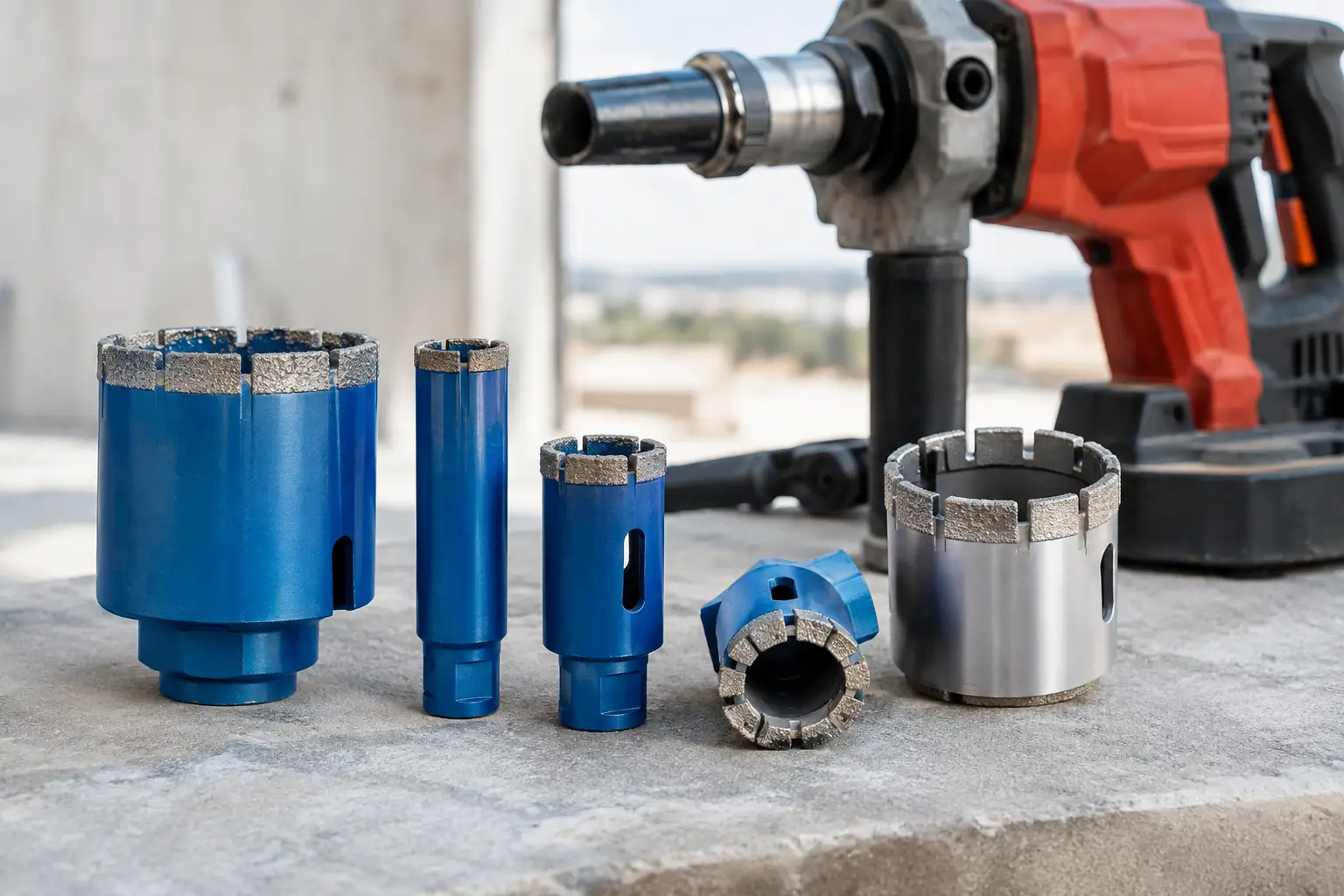
Segment height is another commercial decision. Taller segments normally provide more usable diamond depth and longer service life, which can reduce changeovers on repetitive work. They also increase the initial cost. For occasional drilling, a standard segment height may be sufficient. For rental fleets, utility contractors, and high-volume concrete coring teams, a taller segment can offer better total value if the bond and drilling conditions are correctly matched.
Segment configuration matters most on larger diameters and demanding applications. Turbo or patterned segment designs can improve slurry removal and cutting action in certain materials. Continuous or closely spaced designs may support cleaner hole edges in brittle surfaces. There is no single segment pattern that performs best across concrete, masonry, stone, and ceramic materials.
Confirm Diameter, Working Length, and Connection
Diameter must be selected for the finished hole requirement, not simply the nominal pipe or anchor size. Allowance may be needed for sleeves, fittings, expansion, or installation tolerance. Procurement teams should confirm whether the listed diameter refers to the bit outside diameter and verify the actual hole range expected in the field.
Working length should exceed the drilling depth with enough margin for the application. A short barrel may be lighter and more economical, but it can require repositioning or extension accessories on thicker walls and slabs. Longer barrels improve reach but place higher demands on drill stability, motor torque, and slurry removal.
Connection type is equally critical. Common options include threaded connections for core drill rigs and shank styles for handheld equipment. Ordering the wrong connection can stop work even when the bit diameter and segment specification are correct. For bulk orders, confirm thread type, adapter requirements, and the drilling equipment used by the end customer before production begins.
Large-diameter coring also requires a realistic review of machine capacity. A bit may physically mount on the rig, but insufficient torque or poor anchoring can cause slow drilling, vibration, and premature segment damage. As diameter increases, stable rig setup, proper feed pressure, and adequate water flow become more important.
Evaluate the Job Conditions That Shorten Bit Life
Most premature core bit failures are linked to operating conditions rather than a manufacturing defect. Excessive feed pressure can overheat segments and stress the barrel. Too little pressure can polish the diamonds. Inadequate water flow allows slurry to build up, while poor dust extraction has a similar effect in dry drilling.
Operators should also avoid forcing a bit after it has stopped cutting. A glazed bit may need to be opened by drilling briefly into an abrasive material, depending on the segment design and site conditions. Continuing to push a glazed bit through hard concrete can damage the segment or reduce its usable life.
Rebar is another point where expectations should be clear. A reinforced-concrete bit is designed to handle steel contact, but drilling speed will normally change when it meets heavy reinforcement. Stable feed pressure and proper cooling are more productive than aggressive force. If the application involves frequent, thick rebar or highly engineered structural concrete, request a specification built for that duty rather than relying on a standard general-purpose bit.
Build a Purchase Specification for Repeatable Supply
For distributors and project buyers, a clear purchase specification prevents inconsistent performance across shipments. State the primary material, expected reinforcement level, wet or dry method, diameter range, working length, connection, segment height, and required packaging or private-label details. If the product will serve multiple markets, identify the main application instead of describing it as suitable for everything.
Sample testing should reflect real drilling conditions. Evaluate penetration rate, segment wear, barrel straightness, weld security, hole quality, and consistency across several bits. One successful hole is not enough to qualify a commercial supply program. The objective is stable performance across batches, operators, and job sites.
Ryhyoma supports OEM and ODM core bit requirements with specification-focused manufacturing and quality control. For private-label programs, the most useful starting point is application data: material, equipment, drilling method, target price level, and expected monthly volume. That information allows the bit design to be matched to commercial requirements rather than selected from a generic specification.
A core bit should be treated as a production component, not a commodity accessory. When the material profile, bond, segment design, barrel dimensions, and equipment connection are aligned, crews spend less time correcting drilling problems and more time completing billable work.