A blade that cuts cleanly through one concrete slab can glaze, wander, or lose segments on the next job. The reason is rarely the blade alone. To select concrete cutting blade specifications correctly, purchasing teams must match the bond, diamond concentration, segment design, and blade construction to the actual material and saw conditions.
For distributors, contractors, and fleet managers, the cheapest blade is not necessarily the lowest-cost option. A lower-priced blade that cuts slowly, requires frequent replacement, or creates downtime can raise the total cost of a project. The right specification supports stable cutting speed, predictable blade life, and safer operation across repeated commercial work.
Start With the Concrete, Not the Blade Diameter
Concrete is not one material. Its hardness depends on the aggregate, cement mix, age, moisture level, reinforcement, and curing conditions. These variables determine how aggressively a blade must expose new diamonds during cutting.
A practical starting point is to identify whether the material is green concrete, cured concrete, reinforced concrete, or a heavily abrasive concrete surface. Green concrete is relatively soft and abrasive because it has not fully cured. It generally requires a blade with a harder bond that holds diamonds long enough to avoid premature wear. Fully cured, hard concrete needs a softer bond that releases worn diamonds and exposes fresh cutting points.
This relationship can seem backward at first. Hard material needs a softer bond; soft, abrasive material needs a harder bond. The objective is controlled diamond exposure. If the bond is too hard for cured concrete, the diamonds polish flat and the blade stops cutting efficiently. If the bond is too soft for abrasive concrete, segments wear away too quickly.
Aggregate is equally important. Quartz, river rock, flint, and hard crushed stone can make a slab much more difficult to cut than its surface appearance suggests. When a buyer is supplying blades for varied regional projects, local aggregate should be part of the product selection discussion. A blade specification that performs well in one market may not deliver the same life in another.
Reinforcement Changes the Cutting Requirement
Rebar, wire mesh, and structural steel demand more than a general-purpose concrete blade. The blade must cut both mineral material and metal without segment damage, excessive vibration, or loss of cutting speed.
For reinforced concrete, select a blade designed for heavy-duty concrete and steel contact. Laser-welded segments are commonly preferred for demanding wet-cut applications because the weld provides strong segment retention under heat and load. Segment geometry, diamond grade, and bond formulation should all support intermittent metal cutting rather than only fast cutting through plain concrete.
Do not assume that a blade labeled for concrete will perform equally well on heavily reinforced structural work. Ask for the intended rebar frequency, slab thickness, and saw type before standardizing a blade for bulk supply.
Select Concrete Cutting Blade Construction for the Saw
Blade construction must match the equipment. A high-quality blade can still fail early if it is installed on an unsuitable saw or operated outside its rated speed range.
Handheld cut-off saws, walk-behind floor saws, masonry saws, wall saws, and high-speed electric saws place different loads on the blade. Check the arbor size, maximum RPM, power output, cutting direction, and whether the machine is intended for wet or dry cutting. The blade’s maximum safe operating speed must always be higher than the saw’s no-load RPM.
For walk-behind floor saws, blade diameter and core strength are especially important. Larger blades cutting deeper joints face higher side pressure and heat. A rigid steel core helps maintain a straight cut, while proper water flow removes slurry and reduces heat at the cutting edge. For handheld saws, buyers often need a balance between cutting speed, segment durability, and manageable vibration.
Dry-cut blades typically use segment designs that improve airflow and cooling. They are useful where water supply is limited or where short, intermittent cuts are required. However, dry cutting has limits. Continuous deep cutting creates heat quickly, particularly in hard or reinforced concrete. Wet cutting is usually the better option for long cuts, floor sawing, and production work because it improves blade life, dust control, and cut consistency.
Match Blade Diameter to Required Depth
Selecting a larger diameter simply because it offers more cutting depth is not always efficient. Larger blades usually require more powerful equipment, add cost, and can reduce practical cutting speed if the saw is underpowered.
Choose a diameter that provides the required depth with sufficient clearance for the saw guard and flange system. Remember that the usable cutting depth is less than the blade radius because of the arbor, flange, guard, and machine configuration. For repeat applications such as joint cutting, trench repairs, or slab removal, standardizing the correct diameter helps control inventory and reduces incorrect field substitutions.
Compare Segment Design, Bond, and Diamond Quality
The segment is where cutting performance is created. Buyers should evaluate more than the number of segments or the advertised blade grade.
Segment height affects available cutting life. A taller segment generally provides more wear material, but it does not automatically make the blade better. If the bond and diamond formulation are not matched to the application, extra segment height may only extend the life of a blade that cuts too slowly. For commercial work, the best result is a balanced combination of cutting speed, service life, and stable performance.
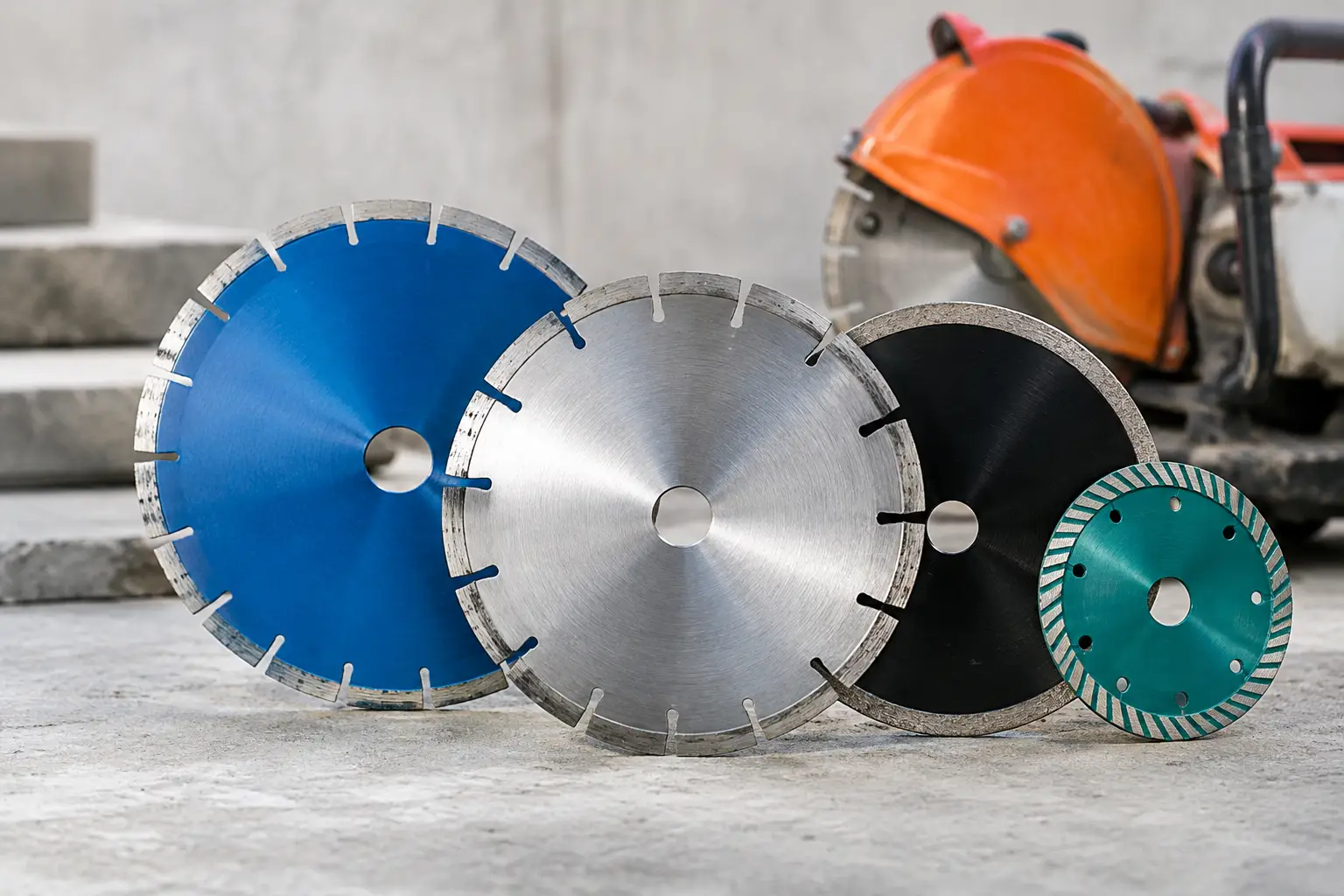
Segment shape also matters. Turbo-style segments can improve cutting speed and cooling in certain applications. Wide or protective segments can improve durability in abrasive conditions. Narrower segments may reduce cutting resistance on some machines, while specialized segment layouts can support reinforced concrete or high-speed cutting. The correct choice depends on whether the priority is rapid penetration, long life, smooth finishing, or resistance to segment wear.
Diamond quality and concentration influence how the blade opens, cuts, and maintains performance. Consistent diamond distribution is critical. Poor distribution can cause uneven wear, vibration, and inconsistent cutting behavior. For distributors building a private-label line, this is one reason factory quality control matters as much as the published specification.
Evaluate Cutting Conditions Before Buying in Volume
A blade should be tested under conditions that reflect the customer’s actual work. A short trial cut in easy material may not reveal glazing, core vibration, segment loss, or poor life in abrasive aggregate.
Before placing a large order, document the material, saw model, blade diameter, wet or dry method, target cutting depth, and average daily cutting volume. Record cutting speed and blade wear over a meaningful number of cuts. Comparing cost per linear foot or cost per job is more useful than comparing purchase price alone.
For procurement teams, a controlled field trial also makes it easier to identify whether problems come from the blade, the machine, or operator practices. Excessive feed pressure, inadequate water supply, worn saw bearings, and incorrect flange support can all shorten blade life. A reliable supplier should help interpret trial results and adjust the specification when necessary.
Avoid the Most Common Selection Errors
The first error is buying a universal blade for every concrete application. General-purpose blades are useful for mixed, moderate-duty work, but they are rarely the best answer for hard cured slabs, frequent rebar contact, or high-volume floor sawing.
The second is selecting on price without measuring productivity. A blade that costs less but requires slower feed pressure or frequent changes can increase labor, equipment idle time, and project delays.
The third is ignoring the cutting method. Running a dry-cut blade continuously in deep cuts or operating a wet-cut blade without adequate water creates unnecessary heat and can damage both blade and saw.
The fourth is treating blade failures as a product issue without checking operation. Glazing often indicates a bond mismatch or insufficient abrasion. Premature segment wear may point to an overly soft bond, abrasive aggregate, or excessive feed force. Core cracks and wobble can result from overheating, side loading, damaged flanges, or machine condition.
Build a Blade Program Around Repeatable Performance
For distributors and large contractors, blade selection should become a controlled product program rather than a one-time purchase. Separate the range by core applications: general cured concrete, reinforced concrete, green concrete, abrasive block and masonry, and high-output floor sawing. This gives sales teams and end users a clearer route to the correct product without carrying an unnecessarily broad inventory.
OEM and private-label programs should also define the required diameter range, arbor options, segment height, packaging, performance target, and market application. Ryhyoma supports this type of specification-led supply model with quality-controlled diamond blade production for bulk and distributor requirements.
The right concrete blade is the one that keeps cutting predictably in the material, on the saw, and at the production volume your customer actually faces. Start with a representative field trial, measure output and wear, then standardize only after the results support a repeatable cost per job.