
A slab can be placed correctly, finished well, and still crack in the wrong location if construction joint cutting is delayed, too shallow, or performed with an unsuitable blade. For contractors and tool buyers, the issue is not simply making a line in concrete. It is creating a planned weak plane that manages shrinkage stress without damaging the slab edges or slowing production.
The terminology also deserves attention. A true construction joint is normally a planned stop and restart point in a concrete placement. Saw-cut joints made after finishing are more accurately called control joints or contraction joints. In jobsite practice, however, construction joint cutting is often used to describe the complete process of cutting joint lines into newly placed concrete. The same fundamentals apply: correct layout, correct timing, controlled depth, and a diamond blade matched to the concrete condition.
Why Construction Joint Cutting Controls Crack Location
Concrete shrinks as moisture leaves the slab. Temperature movement, restraint from subgrade friction, changes in slab thickness, re-entrant corners, columns, and embedded items all add stress. Concrete has high compressive strength but limited tensile capacity. When that tension exceeds the slab's capacity, it cracks.
Joint cutting does not eliminate cracking. It directs cracking beneath a planned line, where movement is less visible and less likely to affect the slab's serviceability. A joint that is cut too late may not activate before random cracks form. A joint cut too early can ravel at the edges, pull aggregate from the surface, or leave a wide, weak groove.
For commercial floors, warehouses, pavements, and exterior hardscapes, joint quality affects more than appearance. Poor joint performance can lead to edge spalling, joint faulting, difficult maintenance, and complaints from the owner. In floor slabs carrying wheeled traffic, damaged joints become a recurring operational cost.
Timing Is the Critical Decision
The correct cutting window depends on the concrete mix, weather, slab thickness, curing conditions, finishing method, and saw type. There is no universal hour count that applies to every project. Fast-setting mixes, hot weather, low humidity, and wind can accelerate shrinkage and narrow the cutting window. Cooler conditions can delay it.
Conventional wet-cut saws are commonly used after the concrete has gained enough strength to resist raveling. Early-entry dry-cut systems can cut sooner because their blades and skid plates are designed for green concrete. Both methods can work well when the crew understands the system and verifies the slab condition rather than relying only on the clock.
A practical field check is to make a short trial cut in an approved location. If the cut leaves intact, clean edges with no significant aggregate pullout, the slab may be ready. If the surface tears or ravels, wait and test again. If random cracks are already appearing, the operation is late and immediate action is required.
Cutting sequence matters on large placements. Start with areas most likely to crack first, including inside corners, narrow panels, slab transitions, and sections exposed to direct sun or drying wind. A saw crew that waits for the entire placement to become ready can lose control of the early-risk areas.
Joint Layout Must Match the Slab Design
The joint pattern should follow the project drawings and engineering requirements. Saw operators should not adjust panel dimensions on site for convenience without approval. Square or near-square panels generally perform better than long, narrow rectangles because shrinkage stress distributes more evenly.
Joints should align with columns, walls, openings, drain locations, and changes in slab geometry where specified. Re-entrant corners need special attention because they concentrate stress. A joint layout that ignores these locations can allow cracks to extend from the corner before the saw cut activates.
Before cutting starts, mark the layout clearly and confirm dimensions against the plan. Straight cuts are not only an appearance requirement. Wandering joints can miss intended load-transfer details, create poor panel geometry, and reduce the professional finish expected on commercial work.
Selecting Blades for Construction Joint Cutting
A joint-cutting blade must match the saw, concrete condition, aggregate hardness, reinforcement exposure, and production target. The lowest purchase price is rarely the lowest operating cost. An unstable blade can cut slowly, glaze over, wander, overheat, or require frequent replacement. Those problems cost more when a crew is waiting on a fresh slab.
For green concrete, the blade requires a bond and diamond specification that can cut efficiently without aggressively tearing the immature surface. For cured concrete, a different bond may be needed to handle higher compressive strength and abrasive aggregate. Hard aggregate often requires a softer bond that exposes diamond more readily, while abrasive materials may benefit from a harder bond that resists excessive wear.
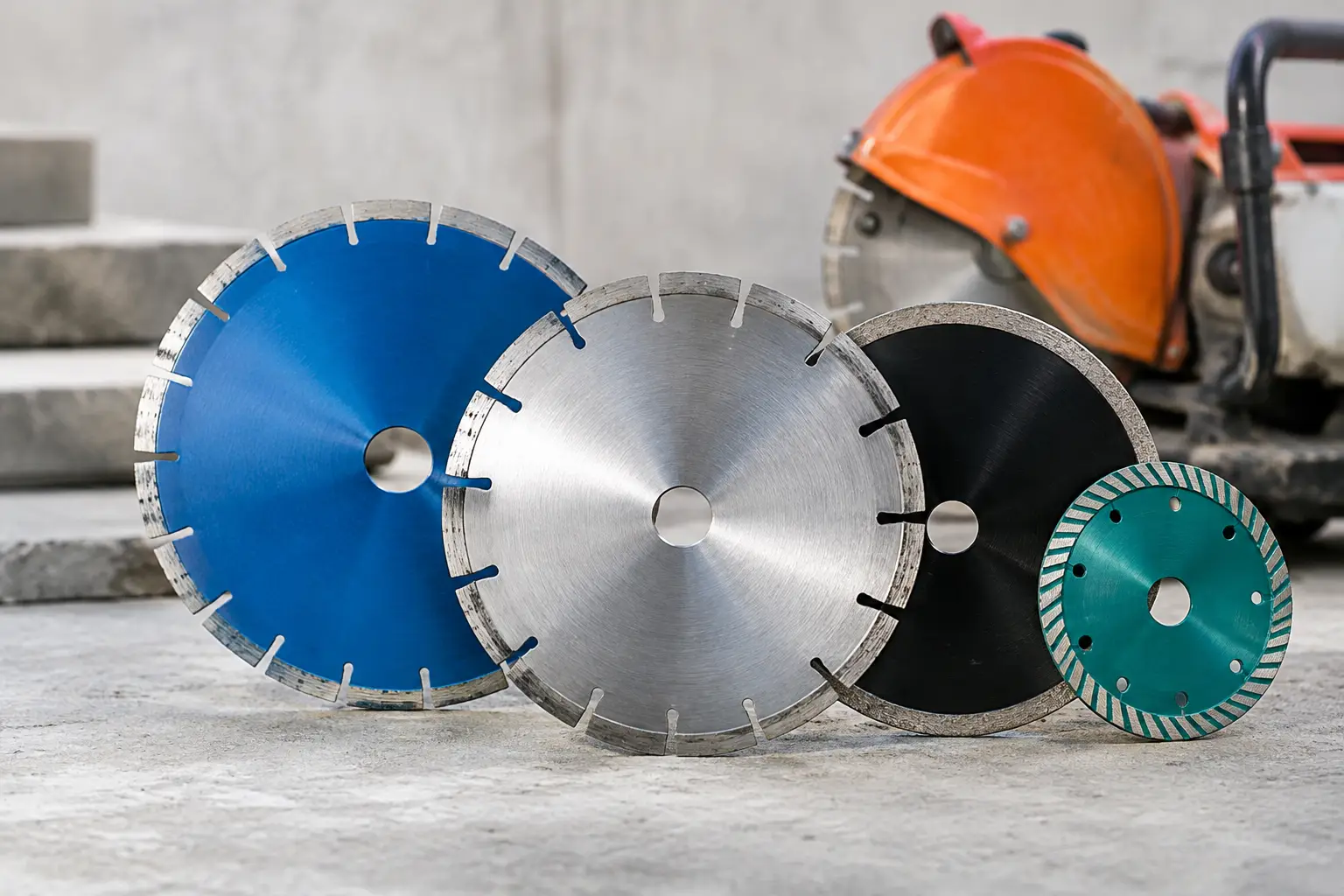
Laser-welded diamond blades are commonly selected for demanding concrete applications because the segment attachment is designed for high heat and sustained cutting loads. Segment design, diamond concentration, and bond formulation should be specified according to the material rather than treated as generic features.
Blade diameter must also match the required joint depth and the saw's rated capacity. A larger blade does not automatically improve performance. It can increase equipment requirements, reduce maneuverability, and create unnecessary operating cost if the needed depth is modest.
Dry Cutting and Wet Cutting Have Different Priorities
Early-entry joint cutting is typically performed dry with equipment engineered to manage dust and protect the green slab surface. Blade selection must support this operating method. Using a general-purpose dry blade where a green-concrete blade is needed can lead to raveling, poor cut quality, and premature wear.
Wet cutting remains common for conventional slab sawing and deeper cuts. Water cools the blade, suppresses dust, and helps remove cutting slurry from the kerf. However, too much water can create a cleanup issue, while too little can overheat the blade. Water flow should reach both sides of the blade and be maintained consistently throughout the cut.
For distributors and procurement teams, this is where supplier capability matters. A blade program should include clear application guidance, stable manufacturing specifications, and repeatable performance across shipments. Ryhyoma supports industrial buyers with diamond tool specifications built around material, cutting method, and commercial operating conditions rather than a one-size-fits-all catalog approach.
Depth, Saw Setup, and Operator Control
Joint depth is usually specified as a proportion of slab thickness, often about one-quarter for conventional saw-cut contraction joints. Project specifications and engineering requirements always take priority. Cutting too shallow may fail to create an effective crack-control plane. Cutting unnecessarily deep increases blade wear, cutting time, and the risk of reaching reinforcement, conduits, or other embedded components.
Before starting, inspect the saw for spindle condition, flange cleanliness, belt tension, blade alignment, engine or motor performance, and water supply where applicable. A quality blade cannot compensate for a saw with worn bearings or damaged flanges. Vibration causes wandering cuts, irregular kerfs, segment stress, and poor joint edges.
Operators should allow the blade to cut at a steady, controlled feed rate. Forcing the saw may cause blade deflection, overheating, or segment damage. Moving too slowly can polish the bond and reduce cutting speed, especially in hard concrete. The correct feed rate produces consistent sound, controlled slurry or dust, and a straight cut without excessive vibration.
Do not twist the blade in the kerf or change direction while it is fully engaged. When a correction is necessary, stop, assess the line, and restart carefully. Small operating mistakes during joint cutting can create visible defects that are difficult to repair after curing.
Common Failures and Their Likely Causes
Random cracking before saw cutting usually points to delayed timing, rapid moisture loss, poor joint layout, or a combination of these factors. Raveled joint edges usually indicate cutting before the slab has sufficient strength, excessive blade aggression, unsuitable equipment, or poor surface finishing conditions.
Slow cutting and excessive heat can indicate an overly hard blade bond, inadequate water flow, insufficient power, or an operator feed rate that is too high. Rapid blade wear may result from an overly soft bond for the aggregate, abrasive sand content, or poor blade specification. Blade wandering often traces back to worn saw components, incorrect blade tension, damaged flanges, or side pressure from the operator.
These are not problems to solve by changing blades blindly. Record the concrete type, aggregate source, slab condition, saw model, cutting method, blade diameter, and observed failure mode. That information allows a tool supplier to recommend a specification based on evidence rather than guesswork.
Build Joint Cutting Into the Placement Plan
Joint cutting should be planned before the concrete trucks arrive. Confirm the joint map, saw availability, backup blades, water access, fuel or power, dust-control requirements, and crew responsibilities. On major placements, a backup saw is often justified because missed timing can cost far more than standby equipment.
The best result comes from treating the saw-cutting crew as part of the placement operation, not as a separate team called after finishing is complete. When the finishing, curing, and cutting schedules are coordinated, joints activate more reliably and blade consumption becomes more predictable.
For repeated commercial work, track blade life and cut quality by concrete application. A consistent record will show whether the blade specification, equipment setup, and cutting window are producing the control the slab requires.