A blade that cuts quickly for the first few minutes but loses its edge before the shift ends is not a low-cost purchase. It is a production interruption. For contractors, fabricators, and distributors, diamond tooling must be specified around the material, equipment, operating conditions, and expected service life - not selected from a generic product description.
The right tool improves cutting speed, finish quality, operator control, and cost per linear foot, square foot, or hole. The wrong tool can glaze, wander, chip an expensive surface, overheat, or fail prematurely. This is why experienced buyers evaluate more than diameter and price when sourcing diamond blades, core bits, grinding blocks, and segments.
Start With the Material, Not the Tool Category
Material composition drives nearly every tooling decision. Concrete varies by aggregate hardness, age, reinforcement level, and whether it is green or fully cured. Natural stone can range from relatively soft marble to dense granite and quartzite. Ceramic, porcelain, and sintered stone surfaces such as Dekton require clean cutting with minimal chipping, while asphalt needs a design that resists loading and heat buildup.
A tool that performs well on abrasive green concrete may wear too fast on hard, dense cured concrete. Conversely, a hard bond intended for highly abrasive material may glaze over on dense stone because the diamonds do not expose at the required rate. The correct specification balances diamond exposure against bond wear.
For procurement teams, the practical question is not simply, “Can this blade cut concrete?” It is, “What concrete, under what machine conditions, at what production volume?” A supplier should be able to discuss the material in operational terms and recommend a bond, segment profile, rim style, or diamond concentration accordingly.
Hardness and abrasiveness are different
Hard materials require the diamond particles to remain exposed long enough to cut effectively. Abrasive materials wear away the metal bond rapidly, so the tool needs a bond that can retain diamonds for a controlled service life. These conditions often pull the specification in different directions.
For example, hard granite typically calls for a different diamond formulation than abrasive sandstone. Reinforced concrete adds another variable: the tool must transition between aggregate and steel without excessive vibration, segment damage, or loss of cutting speed. This is where a general-purpose blade may be acceptable for occasional work but costly in continuous commercial use.
Match Diamond Tooling to the Machine
A correctly specified tool can still perform poorly on the wrong machine. Buyers should identify the equipment type, spindle speed, horsepower, mounting configuration, and whether the application is wet or dry before placing a bulk order.
A handheld cutoff saw places different demands on a blade than a high-horsepower floor saw. A floor grinder requires blocks that match the machine’s tool plate, weight, rotation pattern, and dust-control setup. Core drilling performance depends on drill power, feed pressure, RPM, and water delivery. Ignoring these variables often leads to reports of poor performance that are actually application mismatches.
RPM compatibility deserves particular attention. Every blade and bit has a maximum safe operating speed. The machine must not exceed it, and the operating speed must also support efficient cutting. Excessive RPM creates heat and can accelerate wear. Insufficient RPM reduces cutting efficiency and can cause the tool to pull or bind.
Wet cutting is another decision point. Water controls heat, reduces dust, clears slurry, and supports cleaner results in many stone and concrete applications. Dry-use tools need designs that evacuate dust effectively and manage heat through segment geometry, ventilation, and controlled cutting technique. A dry blade should not be treated as a substitute for a wet blade in a high-volume wet-cutting application unless the manufacturer confirms suitability.
Bond, Grit, and Segment Design Determine Performance
Diamond tooling is an engineered system, not a steel blank with abrasive material attached. Bond formulation, diamond grit size, concentration, and segment or rim design work together to control cutting action and tool life.
Coarser diamonds generally support faster, more aggressive material removal. Finer diamonds typically produce a smoother finish and reduce chipping on brittle surfaces. Neither is universally better. A demolition contractor cutting reinforced concrete may prioritize speed and segment durability, while a stone fabricator cutting polished porcelain may prioritize edge quality and low chipping.
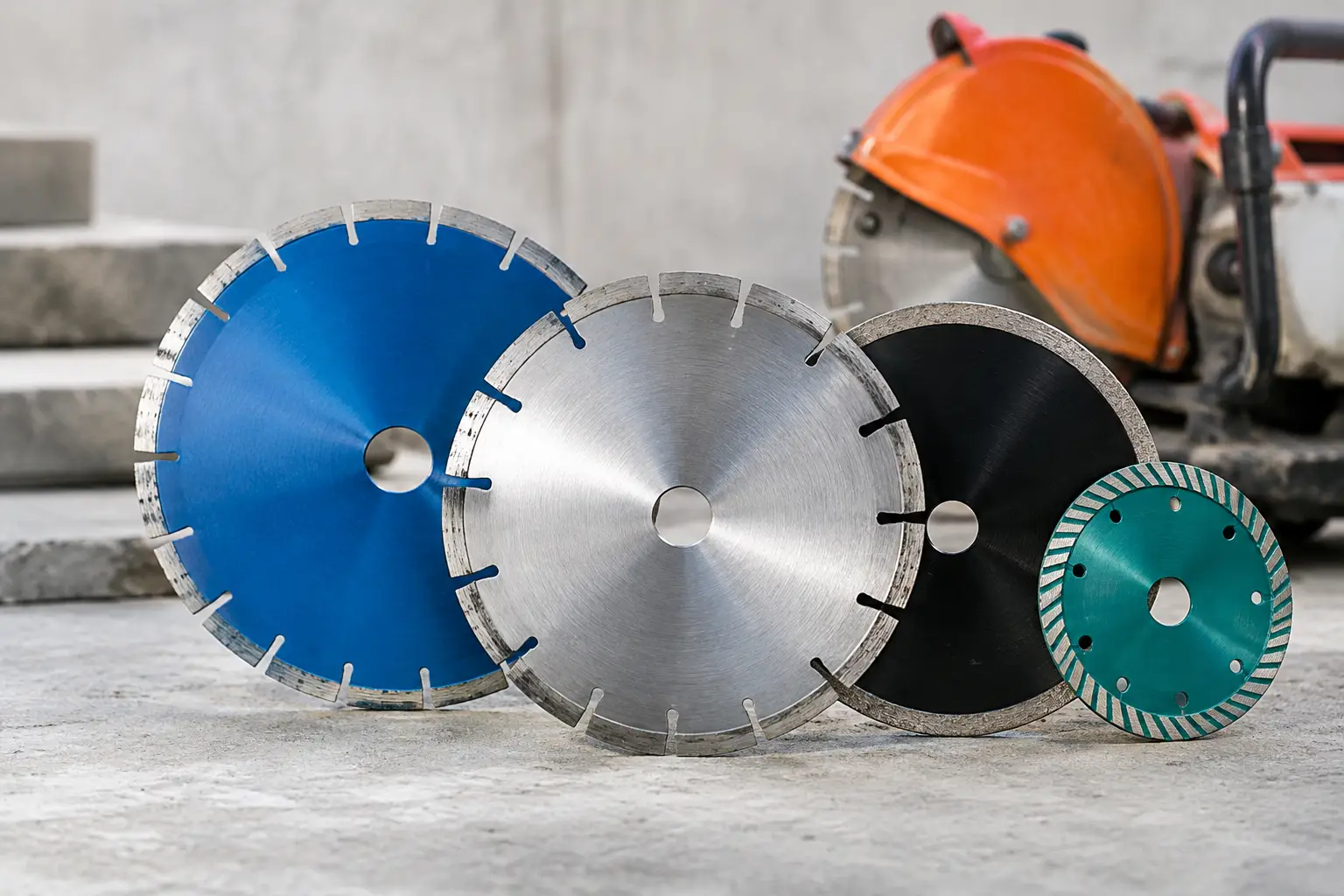
Segment design matters most in heavy-duty sawing and drilling. Segment height influences available cutting depth and potential service life, but height alone does not guarantee longer life. Bond quality and diamond distribution must support consistent exposure through the entire segment. Segment spacing and gullets help clear debris and cool the cutting edge. Turbo rims, continuous rims, segmented rims, and specialized profiles each serve different cutting conditions.
For grinding applications, the number and shape of diamond segments affect aggressiveness, scratch pattern, and floor preparation speed. Double-bar blocks may suit general coating removal, while specialized segment arrangements can be better for hard concrete, epoxy removal, or leveling uneven surfaces. A buyer should avoid treating all grinding blocks with the same mounting pattern as equal products.
Welding Method Is a Quality Decision
The attachment between a diamond segment and the steel core is a critical safety and performance point. Laser-welded blades are widely preferred for demanding dry cutting because the weld delivers strong segment retention under high heat and mechanical load. This makes them suitable for many concrete, reinforced concrete, and construction applications where interruptions and blade failure carry real jobsite costs.
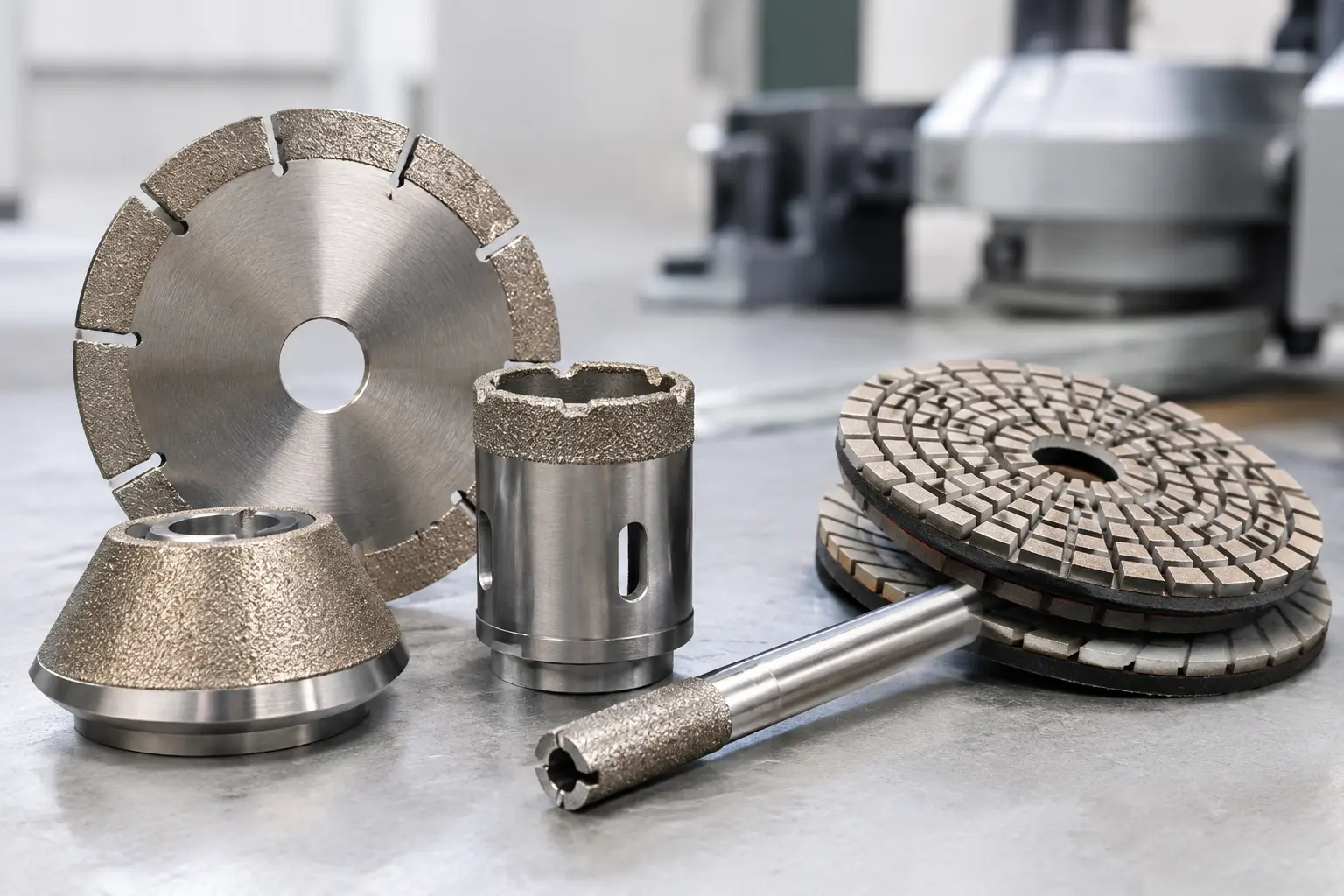
Vacuum-brazed tools use a different approach. They are valued for aggressive cutting and grinding on materials that may be difficult for conventional bonded tools, including some metals, composites, plastics, and certain stone applications. Their performance depends on the diamond coating, workpiece, tool geometry, and operating conditions.
There is no single welding or bonding method that fits every task. The key is matching manufacturing technology to the application and confirming that the supplier maintains consistent process controls. For distributors, that consistency protects the reputation of both the product and the local sales channel.
Evaluate Cost Per Job, Not Unit Price
Low unit price is easy to compare. Cost per completed job is the commercial measure that matters. A cheaper blade that requires frequent changes, cuts slowly, or produces unacceptable breakage can cost more through labor, machine downtime, and material waste.
For recurring applications, buyers should compare tools on measurable field results: average cutting speed, total linear footage, number of holes drilled, square footage ground, finish quality, and failure rate. Testing should use the same material, machine, operator practices, and water conditions wherever possible. A small controlled trial can prevent a large purchasing mistake.
This is especially relevant for wholesalers and private-label buyers. A product line must perform predictably across multiple shipments. If the quality changes between batches, distributors face returns, lost confidence, and a more difficult sales process. Stable manufacturing is often worth more than a small initial price advantage.
What B2B Buyers Should Confirm Before Ordering
A productive supplier discussion starts with clear application data. Share the material, machine model, blade or bit dimensions, arbor or connection type, wet or dry use, expected monthly quantity, and the performance issue you are trying to solve. If the tool will be sold under a private label, provide packaging requirements, artwork expectations, and any target market standards early.
Before approving a larger order, confirm whether the supplier can maintain the agreed specifications across production runs. Ask about incoming material checks, segment inspection, weld quality control, core flatness, balance, dimensional tolerances, and batch traceability. These controls are not paperwork for its own sake. They reduce variation that appears later as vibration, uneven wear, broken segments, or inconsistent cutting results.
OEM and ODM support also requires precision. A custom color or printed label has value, but the technical specification remains the priority. A private-label tool must be matched to the market it will serve. A distributor selling primarily into GCC construction projects, for example, may need products selected for abrasive concrete, high ambient temperatures, and continuous commercial use rather than occasional workshop cutting.
Ryhyoma approaches bulk diamond tool supply as a manufacturing requirement: define the application first, verify the specification, control production quality, and support repeatable performance across orders.
Build a Specification That Can Be Reordered
The best purchase order is one that can be repeated without re-explaining the product. Record the tool type, dimensions, bond recommendation, segment or rim design, diamond grade where applicable, weld method, intended material, machine range, packaging format, and approved sample reference. This creates a usable standard for future purchasing and helps prevent substitutions that look similar but perform differently.
For large buying programs, keep separate specifications for distinct use cases rather than forcing one “universal” tool into every application. A dedicated porcelain blade, reinforced-concrete blade, granite blade, and asphalt blade may require more inventory planning, but they can reduce customer complaints and improve overall job economics.
The practical next step is to review the tools that create the most downtime or the highest return rate in your current range. Bring the material and machine data to the supplier, test against a defined benchmark, and buy the result that delivers dependable performance in the field.