
A poor asphalt blade choice rarely fails without warning. Cut speed drops, the operator starts forcing the saw, the joint edges chip, and blade wear accelerates long before the job is complete. For contractors, rental fleets, and distributors, the cost is not limited to one blade. It includes lost production, equipment strain, replacement inventory, and customer complaints.
Asphalt is softer and more abrasive than concrete, but that does not make it simple to cut. Mix design, aggregate hardness, pavement age, temperature, cutting depth, and saw power all affect blade behavior. Selecting a blade by diameter alone is one of the most common purchasing mistakes. A dependable result requires the blade specification to match the real application.
What Determines the Right Asphalt Blade Choice?
An asphalt cutting blade must balance cutting speed, segment life, and stable operation. The correct balance depends on the jobsite, not just the material name printed on the product label.
Fresh asphalt generally cuts differently from aged pavement. Newer asphalt can be softer and more likely to load the blade with sticky bitumen. Older asphalt may expose hard aggregate and become more abrasive, particularly in high-traffic road sections. A blade that performs well on one surface can wear too quickly or cut too slowly on another.
The equipment also matters. A high-horsepower walk-behind saw can maintain blade RPM and cutting pressure at greater depths. A handheld cutoff saw, ring saw, or lower-power floor saw needs a blade designed to cut efficiently under more limited power. When the blade, saw, and material are mismatched, operators often compensate by pushing harder. That increases heat, causes wandering cuts, and can damage both the blade and machine.
For procurement teams, the practical objective is not to buy the lowest-cost blade. It is to establish a blade specification that delivers predictable footage per blade and acceptable cutting speed across routine work.
Start With the Pavement Condition
Before specifying a blade, identify what is actually in the pavement. Asphalt surfaces can contain different aggregate types, levels of compaction, and repair materials. Roadway asphalt may also include concrete patches, utility covers, embedded reinforcement, or old joint sealant.
A standard asphalt blade is typically designed with a softer bond than a concrete blade. The softer bond allows new diamonds to expose as the abrasive asphalt wears the segment. This helps the blade remain sharp. If the bond is too hard, the diamonds can become polished or glazed, reducing cutting action. If the bond is too soft for the aggregate and operating conditions, segment wear can become excessive.
Mixed-material cutting is a separate consideration. Contractors cutting asphalt over concrete, asphalt adjacent to curbs, or pavement with unknown subsurface material may need a combination blade rather than a blade optimized only for clean asphalt. A combination blade usually accepts some compromise in pure-asphalt cutting speed or life in exchange for safer, more consistent performance when the blade reaches harder material.
This distinction matters for distributors. Supplying one general-purpose blade for every pavement job may simplify inventory, but it can create performance issues for professional users. A focused range with dedicated asphalt, green concrete, cured concrete, and combination blades gives customers a clearer path to the correct tool.
Match Segment Design to the Application
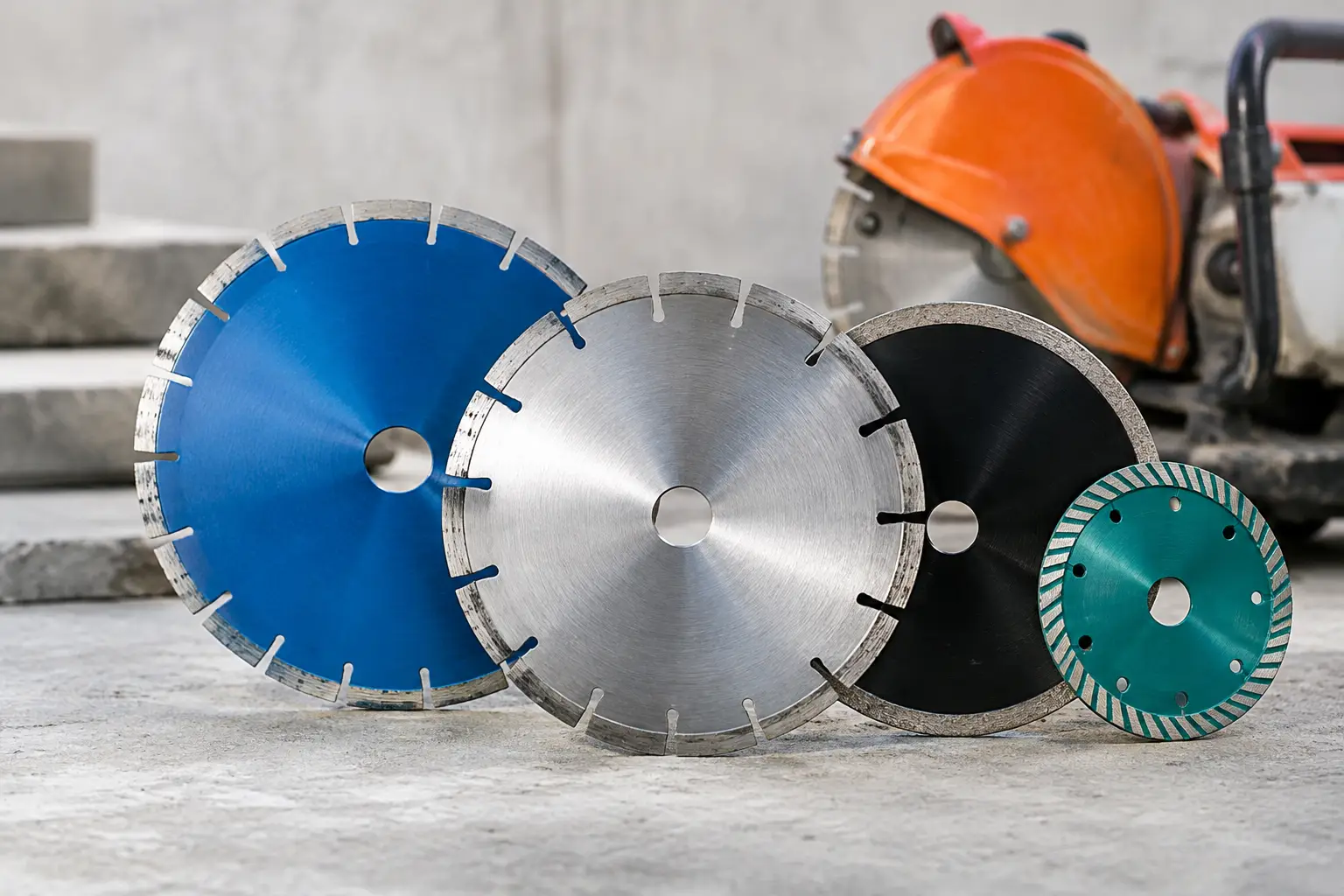
Segment design affects debris removal, cooling, cut smoothness, and blade stability. Asphalt blades commonly use deep gullets and undercut protection because asphalt is abrasive and can erode the steel core below the diamond segment.
Undercut protection is especially valuable in roadwork, trenching, and pavement repair. During cutting, abrasive slurry and aggregate can wear the core near the segment connection. If this area is not protected, the steel core can thin before the diamond segment is fully used. That reduces blade life and creates a safety concern.
For most production asphalt cutting, segmented blades are the practical choice. The open segment spaces help remove asphalt debris and support cooling. Continuous-rim blades are not generally the preferred option for thick road asphalt because they can retain heat and load more easily in demanding cuts.
Segment height is another commercial specification worth reviewing. A taller segment can provide more usable diamond depth and potentially longer service life, but only if the bond and diamond concentration are appropriate. Segment height alone does not guarantee performance. A tall segment with poor bond control can still cut slowly or wear unevenly.
Laser-welded segments are preferred for heavy-duty professional applications because the weld provides strong segment retention under heat and load. For buyers supplying contractors, municipal maintenance teams, and rental fleets, weld quality should be treated as a core requirement rather than a marketing detail.
Choose Diameter and Arbor for the Saw, Not the Shelf
Blade diameter must match the saw guard, spindle, RPM range, and required cutting depth. Larger blades reach deeper, but they also demand adequate saw power and correct operating speed. Installing an oversized blade on unsuitable equipment does not improve productivity. It can reduce RPM under load and produce slow, unstable cutting.
Common asphalt blade sizes include 12, 14, 18, 20, 24, and 26 inches, with larger diameters used on specialized road saws. The required depth should account for the fact that a blade cannot cut to its full radius because of the saw flange, guard, and machine geometry. Buyers should confirm the actual maximum cutting depth of the equipment before selecting a diameter.
Arbor size must also be correct. A blade that does not fit the saw spindle securely can vibrate, produce an inaccurate joint, and increase wear on the arbor hole. Reducer bushings may be used where appropriate, but they must be installed correctly and must not create play between the blade and spindle.
For OEM and private-label programs, clear laser marking for diameter, arbor, application, and maximum RPM helps reduce user error in the field. This is a small specification detail with direct value for distributors and end users.
Wet Cutting, Dry Cutting, and Water Supply
Many asphalt blades are designed for dry cutting, particularly on handheld saws and jobs where water is impractical. However, dry cutting does not mean continuous cutting without attention to heat. Operators should use controlled cutting intervals and allow the blade to run free periodically when necessary.
Wet cutting can control dust, cool the blade, and improve visibility in some road and floor-saw applications. It is especially useful for long, deep cuts with walk-behind saws. The water supply must be sufficient and directed correctly to both sides of the blade. Too little water can create steam and slurry without delivering useful cooling.
The choice depends on site requirements, equipment capability, dust-control rules, and the cut length. A blade marketed for dry use may still perform effectively with water if its specification permits it, but buyers should not assume every blade is intended for both methods. Product instructions and maximum operating parameters should be clear.
Avoid the Operating Errors That Shorten Blade Life
Even a correctly specified blade can fail early when operation is poor. Blade performance should be evaluated alongside cutting practice, saw maintenance, and pavement conditions.
The most frequent problems include forcing the blade through the cut, operating at incorrect RPM, cutting with a worn saw flange, using insufficient water, and making deep cuts too quickly. These conditions can cause overheating, core distortion, segment damage, and uneven wear.
A straight, shallow initial pass is often more effective than immediately attempting full depth. For deep joints, step cutting reduces load and helps the saw maintain RPM. Operators should also avoid twisting the blade in the cut. Side pressure is a common cause of blade wobble, segment cracking, and poor joint quality.
When a blade becomes glazed, the cause is often a bond that is too hard for the material or a cutting method that does not expose fresh diamonds. Before replacing the blade, review the material, saw output, and operating technique. The failure may be a specification issue, but it may also be an application issue.
How B2B Buyers Should Evaluate an Asphalt Blade Supplier
For wholesale and project supply, consistency matters as much as a strong sample result. A blade that cuts well in one trial but varies between production batches creates risk for distributors and contractors. Buyers should evaluate manufacturing control, segment welding method, steel core quality, diamond formulation, labeling accuracy, and batch-to-batch stability.
Technical support is also relevant when supplying diverse markets. GCC roadwork, for example, may involve high ambient temperatures, abrasive desert dust, and extended cutting cycles. A supplier should be able to discuss blade selection by equipment type, aggregate condition, cut depth, and expected production demand rather than offering a generic recommendation.
Ryhyoma supports industrial buyers with laser-welded diamond blade options, controlled manufacturing standards, and OEM/ODM specifications for distributors that need stable bulk supply. For private-label programs, application-specific packaging and product markings can help customers identify the right blade quickly at the point of use.
The best asphalt blade is the one that maintains stable cutting performance on the actual saw, pavement, and work schedule your customer faces. Start with the material and equipment, then specify the bond, segment protection, diameter, and operating method around that reality. That approach turns blade purchasing from a price comparison into a controlled productivity decision.