A laser welded saw blade is usually not the product buyers question after the first successful shipment. It becomes the product they question after a segment loss, a failed roadside concrete job, or inconsistent performance across repeat orders. For distributors, contractors, and procurement teams, the issue is not whether laser welding sounds advanced. The issue is whether the blade holds under heat, vibration, and continuous commercial use.
What a laser welded saw blade actually changes
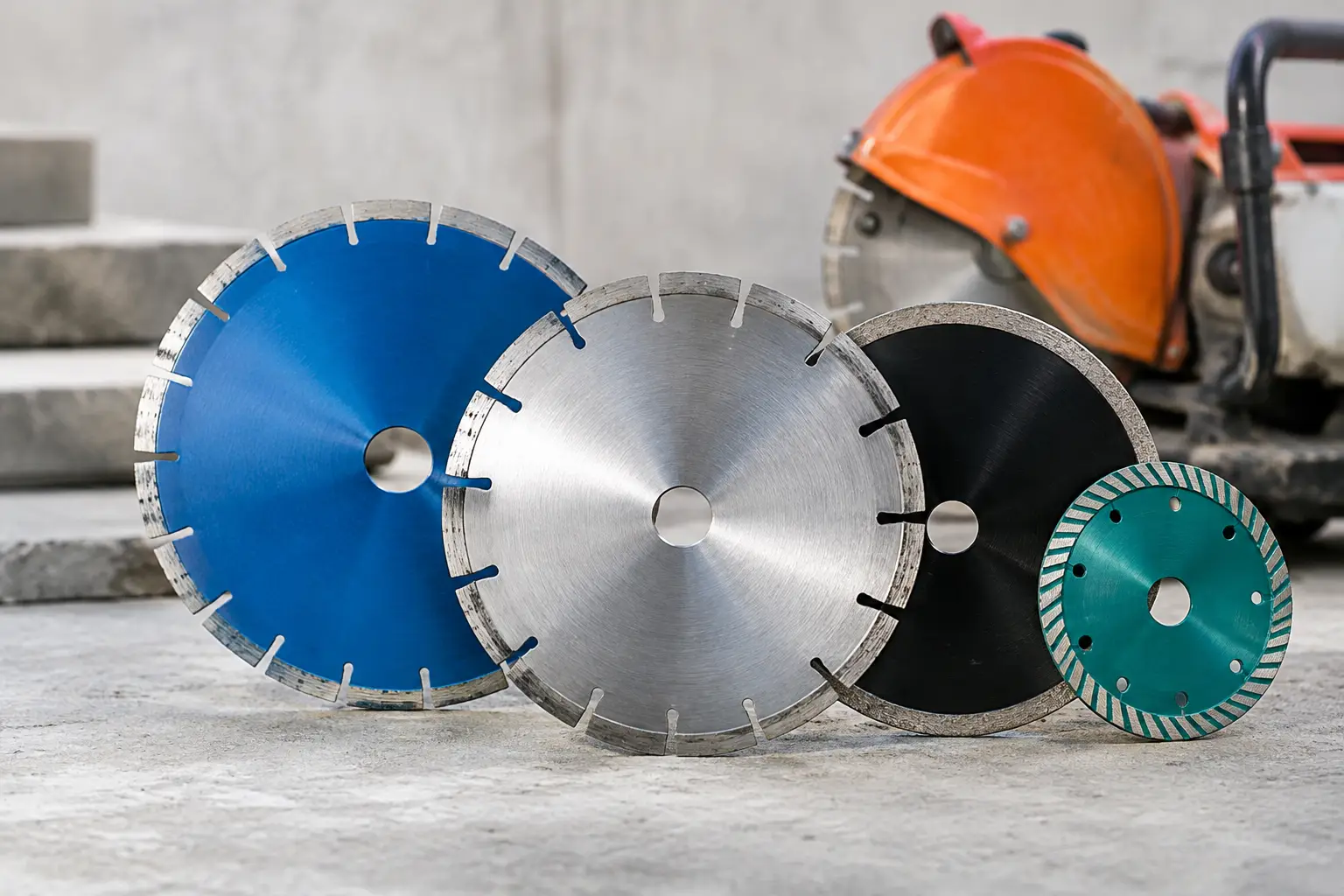
The main difference is at the joint between the diamond segment and the steel core. In a laser welded saw blade, that joint is created by high-energy laser welding rather than silver brazing or lower-strength attachment methods. This produces a much stronger bond, especially in dry cutting and high-temperature conditions where weaker joints can fail.
For industrial users, that matters because blade failure rarely happens in a controlled test environment. It happens on reinforced concrete, on uneven site power, under rushed production schedules, or in hot climates where cutting temperatures rise quickly. A stronger segment-to-core bond reduces the risk of segment detachment and improves operating safety.
That does not mean every laser welded blade performs the same. Welding strength is only one part of the product. Segment formula, diamond concentration, segment height, steel core quality, tensioning, and manufacturing consistency all affect cutting speed and service life.
Why laser welding is preferred for heavy-duty applications
Laser welding is commonly selected for blades used on concrete, reinforced concrete, asphalt, stone, and other demanding materials because it tolerates harsher conditions than many bonded alternatives. Dry cutting is the obvious example. Without water to control temperature, the blade experiences more thermal stress, and the bond must remain stable.
This is one reason professional buyers often specify laser-welded blades for road work, floor sawing, masonry cutting, and site conditions where water supply is limited or inconsistent. The welding method supports a tougher operating range. For export buyers serving GCC markets, where heat and jobsite intensity can be factors, this becomes even more relevant.
Still, preference should match application. A blade designed for aggressive concrete cutting will not necessarily perform well on ceramic tile or engineered stone. The welding method strengthens the structure, but the segment design must still match the material.
Where buyers see the real commercial value
From a procurement standpoint, the value of a laser welded blade is not just durability. It is predictability. A stable blade reduces emergency replacements, operator downtime, and customer complaints. For distributors, it also lowers the risk of returns caused by visible product failure.
In B2B supply, consistency across batches is often more important than one blade that performs well in a sample test. Buyers need to know that the tenth shipment will cut like the first. That depends on process control during steel core production, segment sintering, welding, balancing, and final inspection.
A supplier that understands industrial supply does not sell only on segment height or advertised lifespan. They should be able to discuss application range, machine compatibility, recommended operating conditions, and production control. That is the level where purchasing decisions become safer.
How to evaluate a laser welded saw blade before bulk purchase
The first check is application fit. Buyers should confirm the target material, machine type, cutting mode, and performance priority. Some users want faster feed speed. Others need longer life, smoother cutting, or reduced segment wear on abrasive materials. There is no single best blade without that context.
The second check is the segment and core combination. A high-quality weld on a weak steel core does not solve stability issues. Likewise, a strong core with an unsuitable diamond bond can lead to slow cutting or glazing. Good blade design is a matched system.
The third check is manufacturing consistency. Ask how the supplier controls segment attachment, blade flatness, tensioning, and finished balance. In repeated commercial use, these factors affect vibration, cutting accuracy, and operator confidence.
The fourth check is field suitability. A blade may perform well in lab conditions but behave differently in high-aggregate concrete, heavily reinforced slabs, or abrasive asphalt. Experienced suppliers should be able to recommend different segment formulas for different aggregates and job conditions rather than offering one general-purpose answer for every project.
Dry cutting, wet cutting, and the trade-offs buyers should know
One reason laser welded blades are popular is that they can often handle both dry and wet cutting, depending on the design. That flexibility is useful for distributors who serve varied end users. It is also useful on jobsites where water use changes from one location to another.
But flexibility does not remove trade-offs. Dry cutting increases heat, which can accelerate core fatigue and segment wear if the blade is pushed beyond its intended duty cycle. Wet cutting improves cooling, helps flush debris, and often extends blade life. So even when a blade is capable of dry cutting, wet cutting may still be the better commercial choice for long continuous runs.
Buyers should also consider operator behavior. Many blade complaints come from misuse rather than manufacturing defect. Excessive feed pressure, incorrect RPM, poor machine condition, and cutting materials outside the intended range can all shorten service life. Technical guidance from the supplier is part of product value, especially for private label or distributor programs.
Common problems are not always welding problems
When buyers hear about a failed segment, they often assume the welding is at fault. Sometimes it is, but not always. Segment loss can also result from overheating, side loading, improper blade selection, machine flange problems, or impact during transport and handling.
Slow cutting may point to a bond that is too hard for the material rather than a structural issue. Premature wear can mean the bond is too soft or the material is more abrasive than expected. Blade wobble may be related to core quality, machine arbor condition, or improper mounting. A reliable supplier should help separate product defect from application mismatch.
This matters commercially because the wrong diagnosis leads to the wrong reorder. If the actual problem is material mismatch, replacing one blade with the same specification will only repeat the complaint.
Why OEM and customization matter in this category
For many B2B buyers, an off-the-shelf laser welded saw blade is a starting point, not the final solution. Distributors often need private label packaging, while contractors and importers may need blade specifications adjusted for regional materials, machine standards, or customer price bands.
Customization can include diameter, arbor size, segment height, segment spacing, silent core options, blade color, labeling, and performance tuning for specific materials such as cured concrete, green concrete, asphalt over concrete, granite, or mixed construction materials. The benefit is not cosmetic. The benefit is better fit for the actual market.
A manufacturing partner with stable OEM and ODM capability is usually more valuable than a trader offering a wide catalog without process control. Ryhyoma operates in this manufacturing-focused space, where repeatable quality and technical response are central to long-term supply relationships.
What serious buyers should ask a supplier
A good supplier conversation should move beyond price quickly. Buyers should ask what materials the blade is designed for, whether it is optimized for wet or dry use, what segment bond options are available, how welding quality is controlled, and what testing is done before shipment.
It also helps to ask about batch consistency, MOQ flexibility, packaging standards for export, and lead times for repeat orders. For distributors, after-sales support matters too. If an end user reports fast wear on a specific aggregate, the supplier should be able to review the case and suggest an adjustment rather than treating every complaint as a one-off issue.
Price still matters, of course. But the lowest unit cost can become the highest operating cost if the blade fails early, cuts slowly, or creates return problems in the market.
The right blade is the one that performs repeatedly
A laser welded saw blade earns its place in a product line when it keeps performing after the first order, the first hot-weather shipment, and the first difficult jobsite. Buyers in construction, stone processing, and distribution already know that specification sheets tell only part of the story. The rest comes from process control, correct application matching, and supplier accountability.
If you are sourcing for bulk supply, treat the blade as a production tool, not a commodity. The more demanding the material and the more commercial the workload, the more important that distinction becomes. A dependable blade is not just about cutting. It is about keeping crews working, customers satisfied, and repeat orders on schedule.