
A blade that saves a few dollars at purchase can cost far more when it slows a concrete crew, burns through reinforcing steel, or fails halfway through a scheduled cut. For buyers sourcing bulk diamond blades for contractors, the real requirement is consistent cutting performance across every blade in the shipment, not a low price on the first sample.
Contractors and distributors need blades that match the material, machine, and working conditions their customers face every day. That means evaluating more than diameter and segment height. Bond formulation, diamond concentration, welding method, core design, quality control, and supply consistency all affect whether a bulk purchase performs as expected on the jobsite.
Why Bulk Blade Purchasing Requires a Different Standard
A contractor buying one emergency replacement blade may accept limited product information. A distributor, importer, or contractor managing multiple crews cannot. When blades are purchased in volume, small variations in manufacturing can become expensive operational problems.
An inconsistent batch may include blades that cut at different speeds, wear unevenly, or show premature segment loss. The result is difficult to control: operators change blades too often, job estimates become less accurate, and customer confidence declines. These issues are especially serious on commercial concrete, roadwork, masonry, and stone applications where downtime affects labor, equipment utilization, and project schedules.
The purchase decision should therefore be based on total cutting value. Unit cost matters, but so do blade life, cutting speed, operator safety, predictable stock availability, and the supplier's ability to maintain the same specification on repeat orders.
Specify Bulk Diamond Blades for Contractors by Application
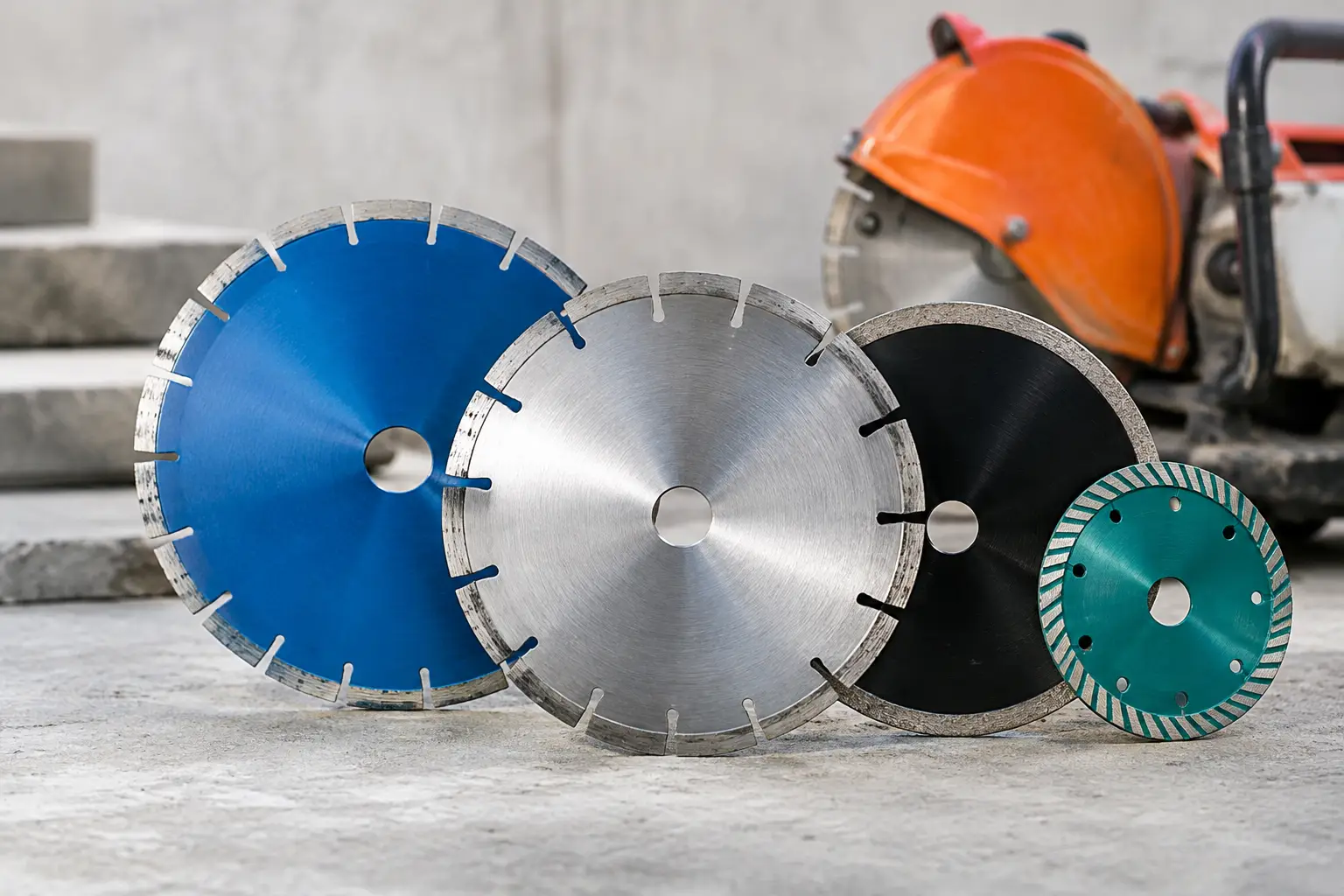
There is no single diamond blade that performs equally well on cured concrete, green concrete, reinforced concrete, asphalt, granite, ceramic tile, and engineered stone. A general-purpose blade may be useful for mixed jobsite work, but it is often the wrong choice for high-volume cutting of a specific material.
For concrete cutting, the aggregate hardness, curing condition, and presence of rebar should guide blade selection. Hard, dense concrete generally requires a softer bond that exposes fresh diamonds efficiently. Abrasive materials may require a harder bond to prevent the segment from wearing too quickly. Reinforced concrete blades also need segment designs and diamond grades that can continue cutting through steel without excessive glazing or vibration.
Asphalt blades have a different requirement. Asphalt is abrasive and can soften under heat, so blades commonly use undercut protection to reduce core wear beneath the segments. Using a standard concrete blade on asphalt may create fast undercutting and a short service life.
Tile, porcelain, granite, and Dekton require more control than open concrete cutting. A continuous rim or fine turbo rim can improve edge quality, while a segmented blade may be faster but more likely to chip a brittle surface. For fabricators, the acceptable finish standard can be as important as cutting speed.
Before requesting a quotation, define the primary application, material condition, machine type, blade diameter, arbor size, wet or dry cutting method, and expected daily usage. This gives the supplier enough information to recommend a practical bond and segment configuration rather than offering a generic catalog item.
Match the Blade to the Saw
A high-quality blade cannot compensate for an incorrect machine setup. Blade diameter, arbor fit, maximum RPM, horsepower, and cutting method must be compatible with the equipment in use. A handheld cutoff saw, walk-behind floor saw, table saw, ring saw, and bridge saw place very different loads on the blade.
For example, a blade intended for a high-horsepower floor saw may not perform correctly on a lower-power handheld saw. The machine may not maintain enough torque to keep the blade cutting freely, increasing heat and reducing life. Likewise, running a blade above its rated speed creates a serious safety risk. Bulk buyers should standardize blade specifications around the machines their crews or customers actually operate.
Construction Details That Affect Performance
The visible segment is only part of the blade. Its performance depends on how the diamonds are held, how heat is managed, and how securely the segment is attached to the steel core.
Laser-welded diamond blades are widely used for demanding dry cutting because the welding process creates a strong connection between the segment and core. This is valuable for concrete, masonry, and other heavy-duty applications where cutting heat is high. For buyers, the key point is not simply that a blade is marketed as laser welded. The manufacturing process must be controlled consistently across the batch.
Segment height is another useful comparison point, but it should not be viewed in isolation. A taller segment can provide more usable cutting depth, yet blade life also depends on bond wear, diamond quality, material abrasiveness, and operator technique. A 15 mm segment that wears at the correct rate can deliver better value than a taller segment with poor diamond exposure.
Core design also matters. Expansion slots, cooling holes, and reinforced centers help control heat, reduce vibration, and support straight cutting. A stable core is particularly important when cutting reinforced concrete or thick materials, where lateral pressure can cause wandering or deflection.
Evaluate Samples Before Committing to Volume
Sampling is not only about confirming that a blade can make a cut. A useful field test compares cutting speed, blade wear, cut quality, vibration, and operator feedback under normal working conditions.
Test samples on the actual material your crews cut most often. Record the number of linear feet or cuts completed, the depth and thickness of the material, the saw used, and whether the operation was wet or dry. If the material contains rebar or hard aggregate, include those conditions in the test. A blade that performs well on a clean concrete block may behave very differently on aged structural concrete.
Compare samples against the current blade in use, not against an unrealistic expectation. The best choice may not produce the fastest first cut. It may be the blade that maintains acceptable speed while delivering a lower cost per foot over its full working life.
For distributors, sample testing should also consider market fit. A premium blade may be the right solution for infrastructure contractors, while a dependable mid-range option may better suit general construction and rental channels. A complete bulk program can include more than one performance tier, provided each tier has a clear application and stable specification.
What to Ask a Bulk Blade Supplier
A supplier should be able to explain what the blade is designed to cut and where its limits are. Vague claims such as "universal" or "long life" are not enough for commercial purchasing.
Ask about the blade's recommended materials, cutting method, maximum operating speed, segment height, segment welding method, core thickness, and available diameters. Confirm whether the supplier can maintain the same bond and segment specification for repeat orders. This is essential when a distributor is building a private-label product line or when a contractor needs a standardized consumable across multiple locations.
Quality control should be part of the discussion. Reliable manufacturers inspect dimensions, arbor accuracy, segment attachment, balance, visual finish, and product marking before packing. For export orders, packaging also deserves attention. Blades need protection against moisture, impact, and core distortion during transit and warehouse storage.
OEM and ODM capability can be useful when standard products do not fit the market. This may include private-label printing, customized packaging, different segment configurations, or a blade specification designed around regional materials and common saw types. Customization should be supported by testing and clear technical approval, not just a changed label.
Plan Inventory Around Usage, Not Guesswork
Buying in bulk should improve availability without creating dead stock. Start with usage data: blade sizes consumed, applications served, seasonal demand, average delivery time, and the number of active crews or customer accounts. Fast-moving sizes such as 12-inch, 14-inch, and 16-inch blades may justify deeper inventory, while specialized sizes can be ordered in smaller planned batches.
It also helps to separate stock by application. Mixing concrete, asphalt, ceramic, and stone blades under a broad "diamond blade" category makes purchasing less accurate and increases the chance that the wrong blade reaches the jobsite. Clear product labeling, application guidance, and organized warehouse locations reduce avoidable errors.
For international buyers, supply reliability includes production planning and communication. A manufacturer that can confirm specifications, provide consistent packing, and support repeat bulk orders gives procurement teams more control over their own delivery commitments.
Ryhyoma supports commercial buyers with laser-welded and application-specific diamond blade options built for repeat industrial use. The objective is straightforward: provide blades that perform consistently, arrive to specification, and support long-term purchasing programs.
The strongest bulk buying decision is the one that keeps crews cutting, distributors stocked, and project costs predictable long after the initial quotation has been approved.