
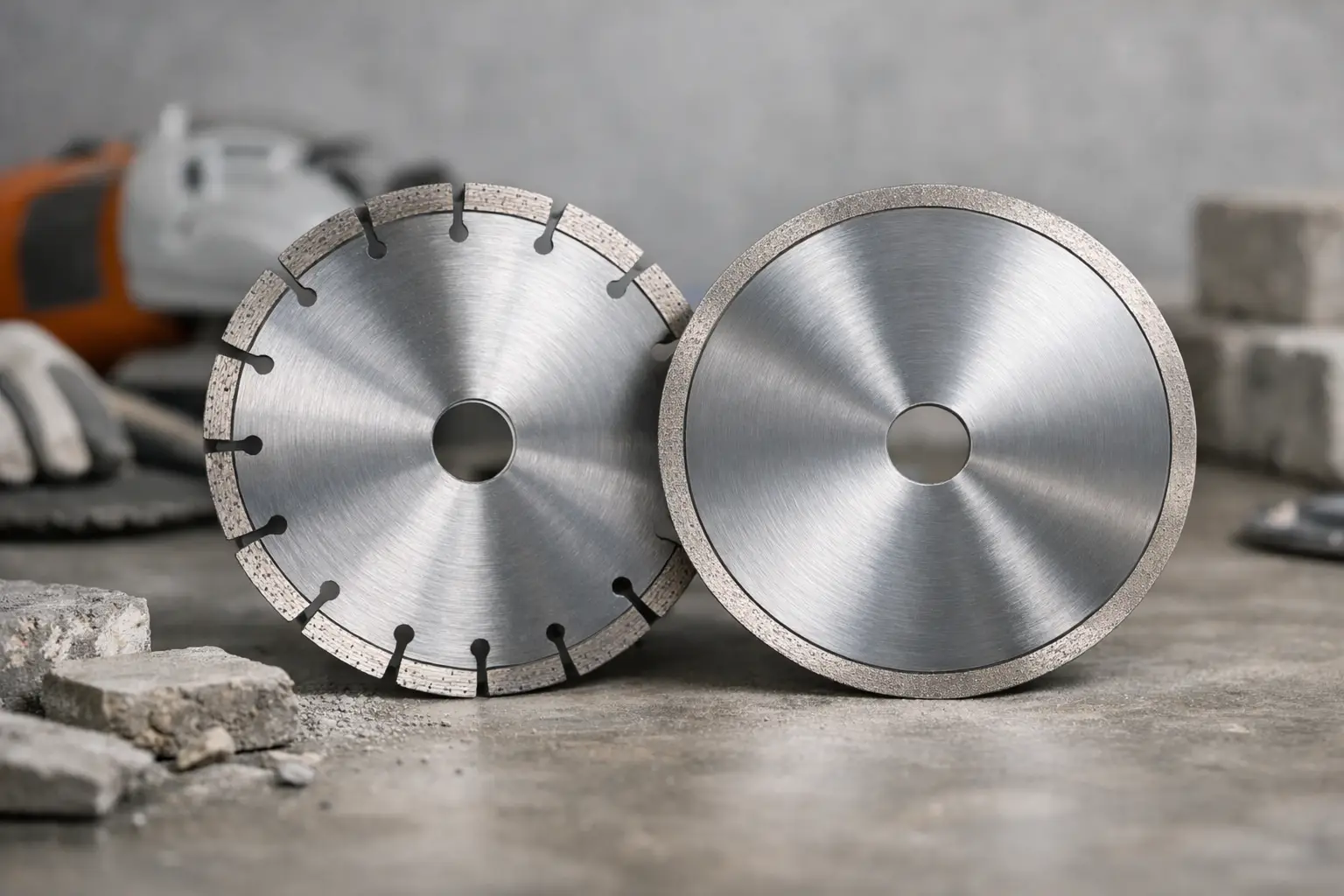
A chipped porcelain edge can turn an otherwise good installation into a rejected job. At the other end of the jobsite, a blade that cuts too slowly through cured concrete can hold up a saw crew and increase operating cost. The segmented versus continuous diamond blade decision is therefore not a minor catalog choice. It directly affects cutting speed, edge quality, heat control, blade life, and customer satisfaction.
For distributors, contractors, and procurement teams, the right answer depends on the material, machine, cutting method, and finish standard. A blade that performs well on block or asphalt may be the wrong choice for glazed tile. Understanding the rim design is the first step toward specifying a dependable product range.
How Segmented and Continuous Rims Differ
A segmented diamond blade has individual diamond-bearing sections around the outer edge, separated by slots known as gullets. Those gaps move dust and cutting debris away from the kerf while allowing air to reach the blade body. This design supports faster, more aggressive cutting and improves cooling in demanding dry-cut applications.
A continuous-rim diamond blade has an uninterrupted diamond cutting edge. Rather than using open gullets, it relies on a continuous band to maintain steady contact with the workpiece. The result is a cleaner, smoother cut with less chipping, particularly on brittle or finished surfaces.
The basic trade-off is clear: segmented blades prioritize productivity and debris removal, while continuous-rim blades prioritize cut quality. However, rim geometry alone does not determine performance. Diamond grit size, segment height, bond hardness, steel core quality, and manufacturing control all matter.
Segmented Versus Continuous Diamond Blade Performance
Where segmented blades perform best
Segmented blades are commonly specified for concrete, reinforced concrete, masonry, brick, block, pavers, and asphalt. Their open rim structure helps clear abrasive dust quickly, reducing the risk that the blade will load up during heavy cutting.
For dry cutting, the cooling benefit is especially valuable. A properly matched segmented blade can maintain cutting action during repeated passes because the gullets help release heat and expose the diamond-bearing edge. This makes the design suitable for hand-held cutoff saws, walk-behind saws, masonry saws, and other equipment used in production environments.
The compromise is the finish. Segmented blades can leave a rougher edge than continuous-rim products, especially at the exit point of a cut. That is often acceptable for structural concrete, site preparation, utility work, and masonry cutting where speed matters more than a polished appearance.
Not every segmented blade is intended for the same material. A blade for abrasive green concrete needs a different bond from one used on hard cured concrete. Asphalt blades often include undercut protection to resist erosion at the segment base. Reinforced-concrete blades require a stable segment design and bond formulation that can manage both aggregate and intermittent steel contact.
Where continuous-rim blades perform best
Continuous-rim blades are generally the preferred choice for ceramic tile, porcelain, marble, glass tile, and other materials that chip easily. The uninterrupted rim supports the surface throughout the cut, which reduces edge breakout and produces a more controlled finish.
These blades are often used wet, especially on tile saws. Water cools the rim, controls slurry, and helps preserve a clean cutting line. When a project involves visible tile edges, backsplash material, polished stone, or premium flooring, a continuous-rim blade is usually the more commercially responsible specification.
A continuous rim is not automatically the best blade for every stone. Granite, engineered stone, and ultra-compact surfaces can require specialized rim designs, high-quality diamonds, and carefully engineered bonds. A standard tile blade may cut these materials slowly or wear prematurely. For hard materials such as porcelain or Dekton-type surfaces, buyers should confirm the intended application rather than selecting by rim style alone.
Continuous-rim blades usually cut more slowly than segmented blades in thick, abrasive construction materials. They also retain more heat when used dry. Pushing a continuous-rim blade too hard through concrete or masonry can cause glazing, loss of cutting speed, core distortion, or visible burning on the material.
Cut Quality Is Only One Part of the Specification
It is easy to select a continuous-rim blade because the job requires a clean edge, or a segmented blade because the job requires fast cutting. Professional buyers need to look beyond that first decision.
The machine must match the blade diameter, arbor size, and maximum operating RPM. Using an incorrect speed can reduce cutting efficiency and create a serious safety risk. Wet-use blades should be run with adequate water flow, while dry-cut blades need appropriate rest intervals when the application creates sustained heat.
Material hardness also changes blade behavior. In general, hard materials need a softer bond that releases worn diamond particles and exposes fresh cutting points. Softer, more abrasive materials require a harder bond so the blade does not wear away too quickly. A manufacturer that can adjust bond formulation and diamond concentration provides more value than one offering a single general-purpose blade for every job.
Steel core stability deserves the same attention. A quality core should remain flat under normal operating temperatures and resist vibration during cutting. Laser-welded segments are commonly selected for high-demand concrete and construction applications because the weld provides strong attachment between the segment and core. Consistent segment placement, weld integrity, tensioning, and final inspection all contribute to predictable field performance.
A Practical Selection Process for Buyers
For a distributor building a product line or a contractor sourcing bulk blades, the most efficient approach is to start with the real application rather than the lowest unit price. Ask what material is being cut, whether the cut is wet or dry, what machine will be used, and how much edge quality the customer expects.
A segmented blade is usually the practical starting point when the work involves concrete, block, brick, pavers, or asphalt and production speed is the priority. Specify a version designed for the material, especially where reinforcement, abrasiveness, or high horsepower is involved.
A continuous-rim blade is usually the safer starting point for ceramic, porcelain, marble, and finish-sensitive stone. Confirm whether wet cutting is available and whether the material has a glazed, polished, or dense surface that requires a specialized formulation.
For applications between these two categories, a turbo-rim blade can be relevant. Turbo blades use a continuous-style rim with patterned grooves or serrations to improve cooling and cutting speed. They can offer a useful balance for some masonry, tile, stone, and general construction tasks, but they are not a replacement for a correctly specified segmented or continuous-rim blade.
When evaluating a supplier, procurement teams should request test samples based on their own material and equipment. A controlled comparison should measure cutting speed, total linear footage or number of cuts, edge condition, segment wear, vibration, and consistency across multiple blades. One successful sample is useful; repeatable batch performance is what protects a distributor's reputation.
Common Selection Errors That Increase Cost
The most common mistake is using a general-purpose blade on a specialized material. A low-cost blade may appear competitive until it chips expensive porcelain, slows a concrete crew, or fails before the planned number of cuts. The purchase price is only one component of the total cutting cost.
Another error is forcing the blade through the workpiece. Excessive feed pressure generates heat, reduces diamond exposure, and can damage both the blade and machine. Operators should let the blade cut at its intended rate, especially with continuous-rim products.
Buyers should also avoid treating dry and wet cutting as interchangeable. Water changes temperature, dust control, and slurry removal. A blade engineered primarily for wet tile cutting may not deliver acceptable life or safety margins when operated dry in a continuous production setting.
For OEM and private-label programs, specification control is essential. The same printed diameter does not guarantee the same performance. Define the rim type, segment height, bond target, core thickness, arbor configuration, packaging, application label, and quality inspection requirements before moving to volume production. Ryhyoma supports this type of application-based specification process for distributors that need stable, repeatable diamond tool supply.
Choose for the Job, Then Verify in the Field
A segmented blade earns its place where aggressive cutting, dust clearance, and productivity matter most. A continuous-rim blade earns its place where every visible edge must remain clean. The better commercial decision comes from matching the blade to the material and operating conditions, then validating the specification under actual jobsite loads.
For buyers managing repeat orders, keep records from field trials: material type, machine model, wet or dry method, cut rate, blade life, and operator feedback. Those records turn blade selection from a one-time purchase decision into a controlled supply standard that can support reliable performance across every shipment.


